

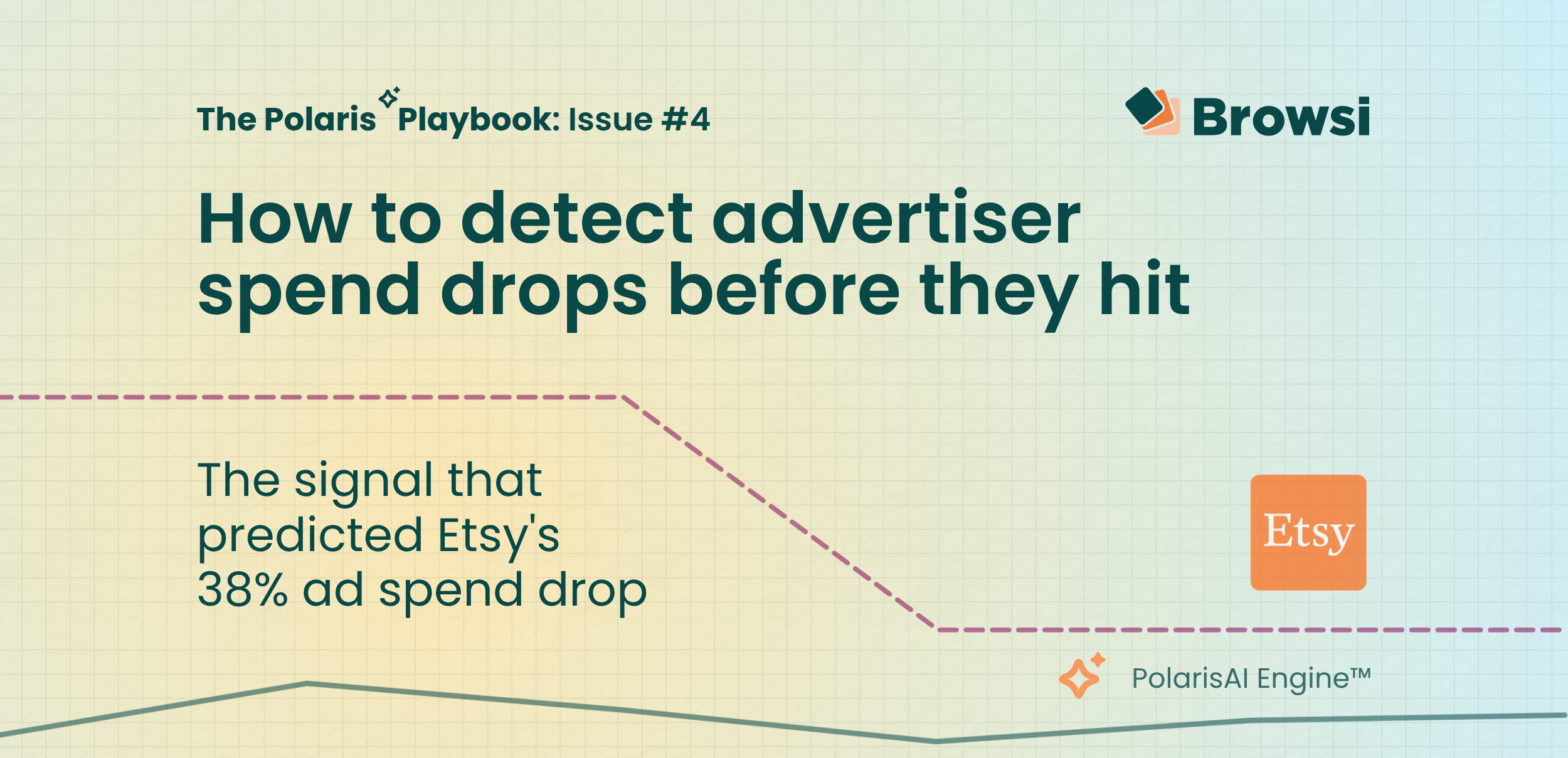
How to Detect Advertiser Spend Drops Before They Hit
Etsy's earnings confirmed what PolarisAI had already seen: a major pullback in marketing investment. By analyzing competitive signals before quarterly results were released, PolarisAI projected a 38% decline in spend while the market was still reacting to the underlying changes. The result highlights a growing reality for marketers: the most valuable competitive insights often emerge long before earnings calls explain them.

Asaf Shamly CEO & Co-Founder
Case studies
View all-
How to Detect Advertiser Spend Drops Before They Hit
Etsy's earnings confirmed what PolarisAI had already seen: a major pullback in marketing investment. By analyzing competitive signals before quarterly results were released, PolarisAI projected a 38% decline in spend while the market was still reacting to the underlying changes. The result highlights a growing reality for marketers: the most valuable competitive insights often emerge long before earnings calls explain them.
View Now -

How Accurate is Browsi’s Data? Tried and Tested.
Most marketers trust competitive spend data without questioning where the numbers come from. We tested PolarisAI Engine™ against the only benchmark that matters: what advertisers actually reported in their earnings calls. The result was an 87% correlation across five major brands, revealing the difference between data that looks confident and data grounded in reality.
View Now -
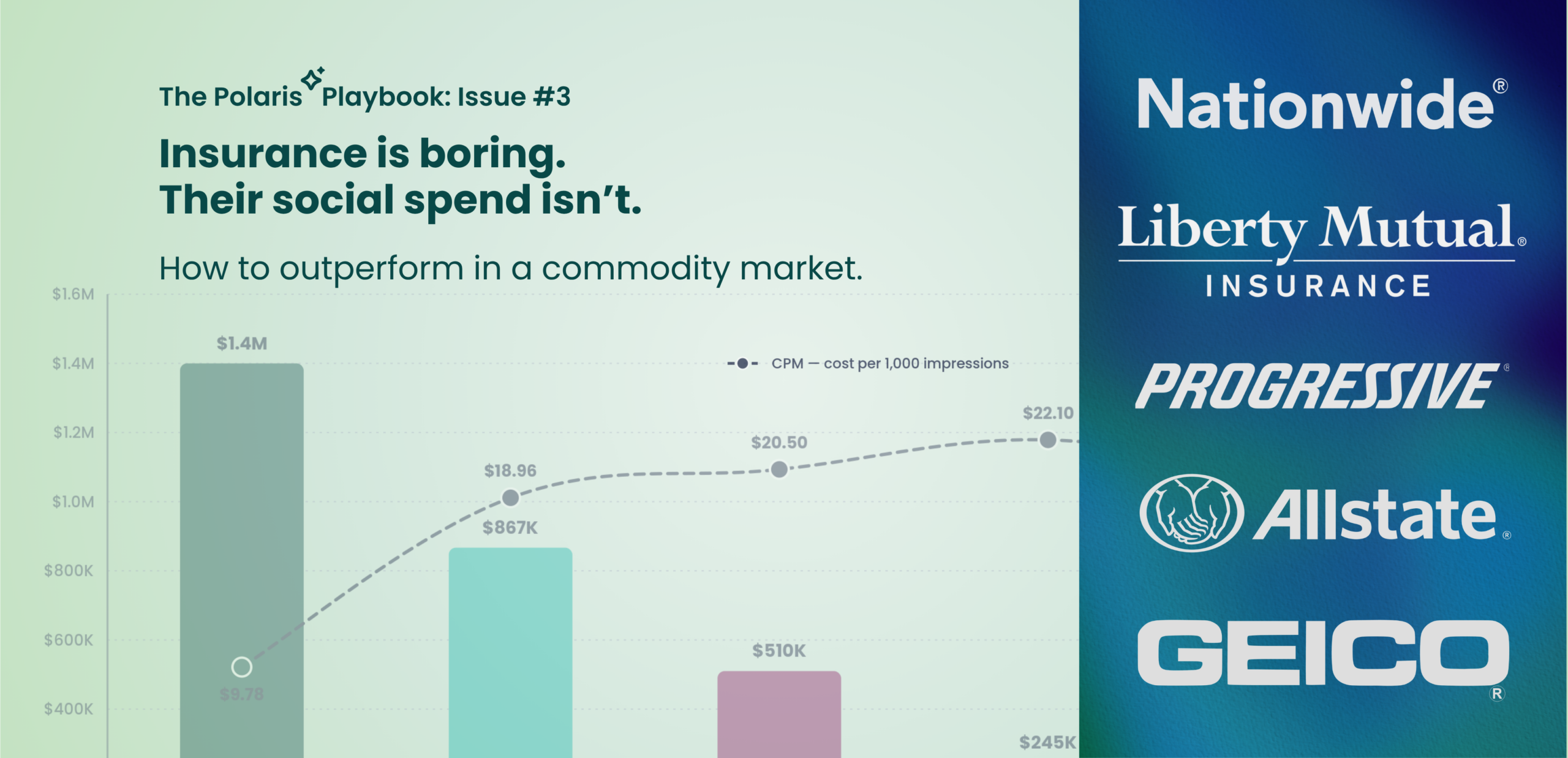
Insurance is Boring. Their Social Spend Isn’t.
Insurance products may look the same, but advertising performance doesn’t. In this edition of the Polaris Playbook, we analyze how Progressive, GEICO, Allstate, Liberty Mutual, and Nationwide allocate social ad spend — and uncover why Progressive’s CPM is more than 50% lower than competitors despite being the category’s biggest spender. The data reveals a broader competitive advantage hidden inside the auction itself.
View Now -
Most brands think they are data driven. They’re not.
In this breakdown, we use PolarisAI to compare American Express and PayPal, uncovering how PayPal achieved comparable performance with dramatically lower spend through smarter targeting, simpler messaging, and more efficient execution.
View Now -

Why Ad Tech Might Be Missing the Target: The Blind Spot OpenTTD Reveals
The Trade Desk’s OpenTTD highlights a shift in ad tech as advertising platforms evolve into larger ecosystems. While this consolidation simplifies media buying workflows, it can also create a blind spot, limiting visibility into the broader competitive landscape shaping programmatic advertising.
View Now -

The Doctor Everyone’s Seeing: YouTube, AI Search, and the New Rules of Visibility
Google’s AI Overviews are reshaping discovery by deciding which sources appear in answers — often before users ever click. As search shifts from clicks to citations, traditional performance metrics no longer tell the full story. This article explores what visibility really means in an AI-mediated web, and why competitive intelligence is now essential.
View Now -

The Vanishing Web: What Google’s Admission Really Means for Advertisers
For years, Google insisted the open web was thriving. Then, in a legal filing, it admitted the opposite. For advertisers, the real risk isn’t where ads run, but how much of what happens around them can still be seen, understood, and measured.
View Now -
What the RSL Standard Signals About the Future of Visibility in 2026
When Reddit, Yahoo, Medium, and several of the web’s biggest content platforms announced a new Really Simple Licensing (RSL) standard, most coverage focused on the politics: platforms finally demanding compensation from AI companies; a new legal framework for training data; the good old open-web fight. But if you take one step back, something bigger comes into focus. For the first time, publishers are trying to engineer visibility - not for users, but for AI agents. And advertisers should be paying attention.
View Now -

When the Pipes Change, So Do the Rules: What OpenAds and AdCP Signal for Advertisers
Programmatic’s foundations are shifting. As control moves closer to publishers and planning logic becomes more open and inspectable, two developments - OpenAds and AdCP - are redefining how ad decisions are made. Together, they signal a new era where fewer intermediaries, clearer signals, and transparent coordination reshape the rules for advertisers.
View Now -

When AI Becomes the Storefront, Advertisers Need to See Beyond the Chat Window
ChatGPT Shopping quietly introduced a massive shift: AI is becoming the new storefront. Discovery, comparison, and checkout now happen inside a single conversation - no website required. For advertisers, this means visibility depends on how well their message can be interpreted, ranked, and surfaced by AI systems that control attention.
View Now -

Visibility Multiplies – But Only If You Measure What Matters
Visibility doesn’t guarantee impact. New research reveals that mentions (not backlinks) drive visibility in AI search, and the same principle applies to media performance. When advertisers focus on attention and context, visibility doesn’t just show up—it multiplies.
View Now -

You Get What You Surface: How GPT-5 Exposed the Quiet Power of Defaults
The GPT-5 rollout quietly exposed how much defaults shape trust, perception, and engagement. When technology changes without context, even progress can feel like loss. In AI and advertising alike, it’s a reminder that the way we present intelligence — not just how we build it — determines what people understand, value, and believe.
View Now