

The Doctor Everyone’s Seeing: YouTube, AI Search, and the New Rules of Visibility
By Asaf Shamly | January 29, 2026

Google’s AI Overviews may be the most powerful change in search – not because they’re flashy, but because they are quietly deciding what people see.
A recent study looked at more than 50,000 health-related searches. What it found is unsettling.
YouTube – not hospitals, not government health sites – was the most cited source in Google’s AI answers
More than any medical institution.
More than any authority we’d normally trust.
At first, this sounds like a healthcare problem (and it probably is if most medical advice now comes from Dr. YouTube, MD.)
But the bigger issue is what this says about visibility.
Today, visibility about being chosen.
And the metrics we’ve relied on (organic position, paid click share, impressions)? They’ll tell you how you performed inside a system, but not whether you were visible inside the answer.
That gap is where brands quietly start losing ground and without realizing it.
Search is becoming less about clicks and more about citations.
People have been warning about this for a while now.
Users get answers without clicking. Organic traffic drops, even when rankings don’t.
And visibility starts to depend less on where you rank and more on whether the AI chooses you at all.
If your content doesn’t show up inside the answer, you’re effectively not there. At least not in that moment.
And here’s the real problem: the metrics we still rely on won’t tell you that.
SERP position. Impressions. Even paid reach.
They show how you performed inside the system.
Not whether you were part of the story the user actually saw.
That’s a serious blind spot for advertisers.
YouTube’s dominance points to something bigger.
It’s not hard to see why YouTube shows up so often.
Billions of videos.
Billions of hours watched.
And a constant stream of signals the algorithm already knows how to interpret.
But unlike medical journals or government health sites, YouTube is… YouTube.
Anyone can publish.
Anyone can be an expert.
And yet, in AI Overviews, YouTube is treated like an authority.
And what’s happening to our content in the meantime?
Click-through rates drop when rankings don’t.
Paid ads get pushed further down the page, below the answer itself.
Strategies built entirely around blue links start to feel less reliable.
And while nothing breaks all at once, we can all admit, something has just stopped working the way it used to.
When Visibility Stops Following the Rules
The old model assumed something simple: optimize each channel, trust platform reports, measure performance from internal dashboards.
That model breaks when discovery happens before the click.
Because now the real questions aren’t about position or impressions. They’re about presence.
– Who does the AI reference?
– Which brands get pulled into the answer?
– And who quietly disappears even while “performing well” on paper?
AI Overviews are powered by custom versions of Google’s Gemini. But despite the documentation, a lot is left unsaid.
Google explains what the system does, not how it decides.
We don’t know the exact scoring logic. We don’t know how sources are weighted. We don’t know how conflicting information is resolved.
Which means visibility is no longer governed by a transparent set of rules. It’s shaped by patterns. Signals. Attention.
And in that environment, attention wins over truth.
So the real question isn’t how do we rank higher? It’s how do we earn attention in a system that decides before anyone clicks?
Why Better Competitive Intelligence Is Now Non-Negotiable
Here’s the bottom line.
When discovery shifts from clicks to AI-driven context, visibility becomes a competition for inclusion, not just exposure.
The battle moves into the answer layer itself.
That’s where competitive intelligence becomes essential.
Not to count impressions or celebrate clicks but to understand where you stand relative to everyone else competing for the same attention.
Who’s gaining share of voice.
Who’s shaping the narrative?
And where momentum is quietly shifting.
Because when AI can choose any source to answer a question, raw performance stats stop being enough.
What brands need instead is competitive truth.
Only with that truth can you answer the question that actually matters now: not just did we show up, but how did we stack up?
And in an AI-mediated world, that’s not a nice-to-have.
That’s survival.
Latest Articles
-
The World Cup’s best advertising window isn’t the final.
Conventional wisdom says the knockout rounds are the best time to advertise during the FIFA World Cup. PolarisAI's analysis of Meta campaigns across major beverage brands tells a different story. By comparing Coca-Cola's official World Cup creative with Pepsi's tournament-adjacent strategy, we found that advertising efficiency peaked earlier in the tournament, even as audiences continued to grow.
View Now -
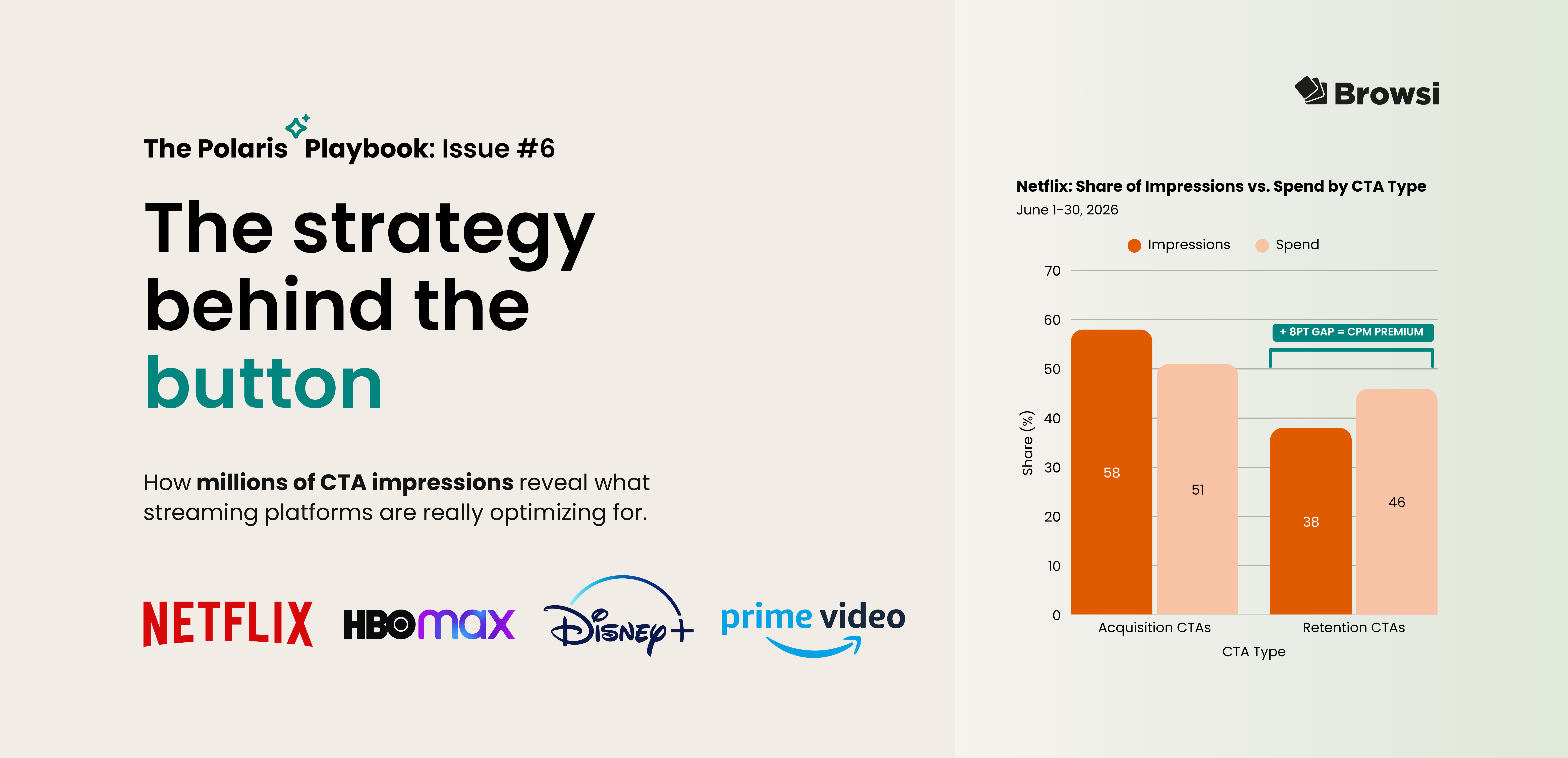
The strategy behind the button: What millions of CTA impressions reveal about competitive strategy
What can a single CTA button reveal about a company's marketing strategy? By analyzing millions of Meta ad impressions, PolarisAI uncovers how Netflix, Prime Video, HBO Max, and Disney+ use "Sign Up," "Watch More," and other CTAs to prioritize subscriber acquisition, viewer engagement, and broader competitive strategy.
View Now -
The 6-step framework for turning signals into strategy
Competitive intelligence only matters if it leads to action. In this edition of The Polaris Playbook, we use Honda and five competitors to demonstrate a practical six-step framework for turning competitive signals into strategic recommendations marketers can actually use.
View Now