

The Vanishing Web: What Google’s Admission Really Means for Advertisers
By Asaf Shamly | January 6, 2026

For years Google has been the loudest voice assuring us that the web is alive and well.
Then, several weeks ago, under oath, it said something else.
In a submission to the U.S. Department of Justice, Google admitted that “the open web is already in rapid decline.” It was a brief line in a legal argument about its ad business, but for publishers and advertisers, it puts into writing what many have been feeling for years:
Traffic is thinning.
Reach is shrinking
The web as we know it – open, measurable, and interconnected – is changing.
Today, the impact of that shift is no longer theoretical.
Weeks after the filing, The Guardian reported that Google’s AI-powered search is cutting traffic to independent publishers, as answers are increasingly delivered via AI summaries rather than source links. For many, the loss of open-web discovery has translated directly into lost revenue and visibility.
Publicly, Google continues to claim that search is “sending more traffic than ever.” In a legal context, however, it is forced to admit that user behavior, ad spend, and attention are migrating elsewhere – toward connected TV, retail media, and increasingly, AI-powered interfaces that don’t rely on the traditional web at all.
This isn’t legal talk. It’s an indication of the deeper split in digital media: the gap between what platforms measure and what advertisers are able to see and validate is growing.
Fading slowly, not collapsing
I wouldn’t say that the open web is dying, but it is changing, through thousands of (not so) quiet shifts in how users discover and consume content.
Once, discovery started on an ad or a search results page.
Now it begins in a prompt, a chat, a recommendation feed, or a voice interface.
Each of these surfaces still draws from the web, but they filter and repackage it before the user ever reaches a publisher’s page. The experience feels seamless, but the visibility – the trail of data, context, and attribution – becomes more blurred than ever. Because the web isn’t disappearing – it’s fragmenting. And in that fragmentation, the ability to see clearly becomes the real differentiator.
Advertisers don’t need to rely on a single channel or interface to understand performance.
What they need is visibility that travels with them – across environments, across platforms, across formats. Knowing where an ad appeared, what competed for attention, and how it performed against peers is the new baseline for intelligent media.
It’s where technology steps in – to connect the dots between environments, restore context, and turn exposure into understanding.
Detecting signals in a shrinking environment
For years now, advertisers have been operating with fewer and fewer reliable indicators of impact. Viewability thresholds and click-through rates still exist, but they don’t describe the complexity of how media is consumed.
The benchmark accessible metrics often tell an incomplete story.
“Reach” doesn’t mean attention. “Delivery” doesn’t mean visibility. And “impressions” rarely mean impact.
That’s why this moment matters.
Because in a world where even Google admits the open web is shrinking, what advertisers measure – and what they don’t – will decide who stays relevant.
Instead of blaming platforms, it’s time to rethink visibility
It’s tempting to treat this as another turning point where the industry must pick a side: open versus closed, AI versus human, web versus app.
But that framing misses the point.
The question isn’t where advertising happens. It’s how much of it we can still see.
And very naturally, what’s emerging now is a new kind of literacy – one that requires advertisers to read signals, not instead of reports.
To understand the quality of an impression, beyond quantity.
To see placement, timing, and environment dynamically.
It’s a shift that requires a wider lens. Instead of asking “how many ads did we serve?”, the better question is “what actually happened around our ads?”
What other brands appeared beside us?
How much attention did we hold?
Which contexts lifted performance, and which quietly drained it?
These aren’t futuristic questions. I claim they’re survival ones.
Looking at what’s left – and what’s still important
If the open web is fading, what replaces it won’t be a single platform or format.
It’ll be a mess of environments – each competing for the same seconds of human attention.
The advertisers who win will be the ones who know how to see across platforms, trace attention back to context, and measure presence in ever-changing mediums.
Clarity is still possible. It just takes sharper eyes (and better tools) to find it.
Latest Articles
-
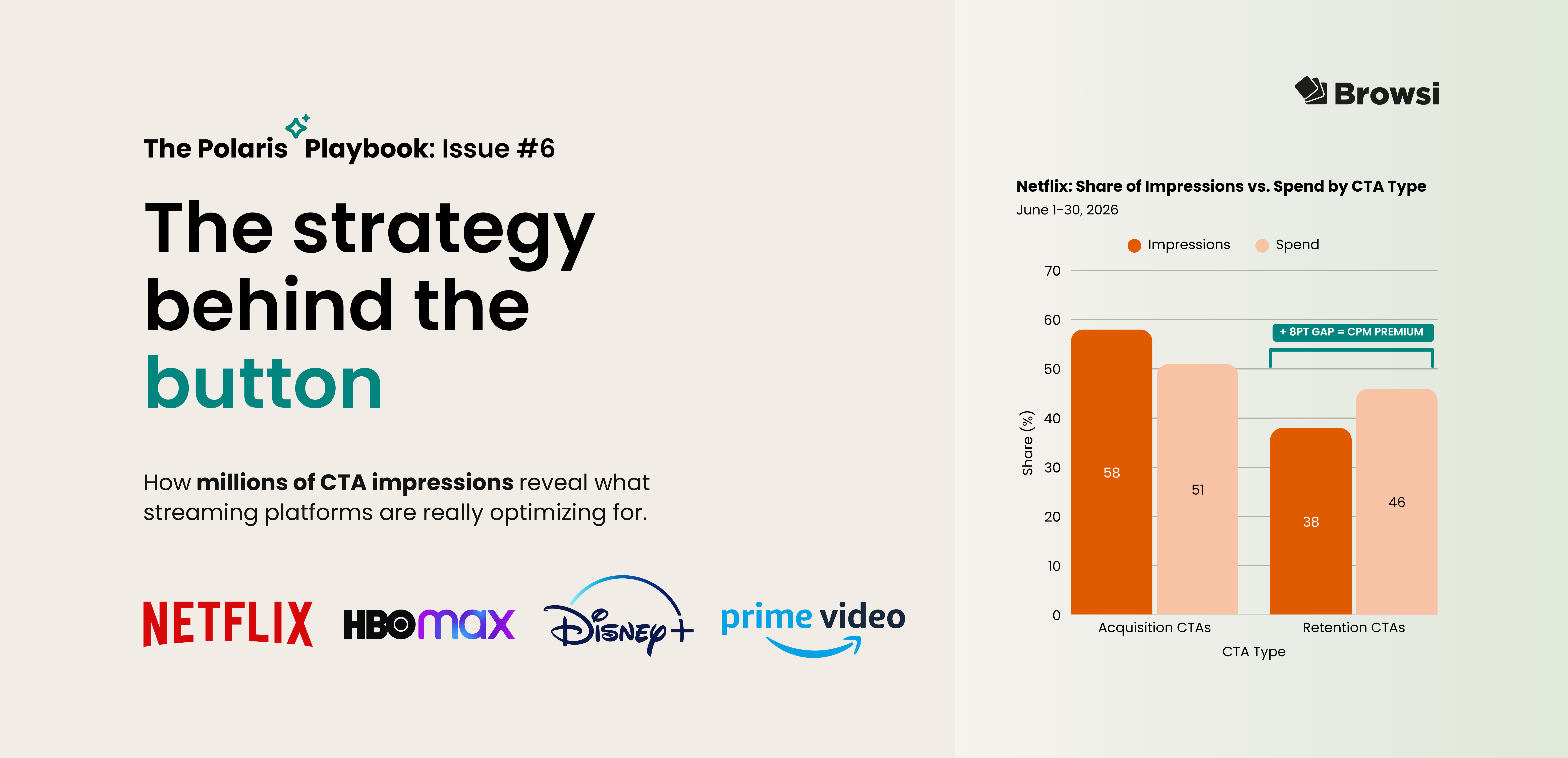
The strategy behind the button: What millions of CTA impressions reveal about competitive strategy
What can a single CTA button reveal about a company's marketing strategy? By analyzing millions of Meta ad impressions, PolarisAI uncovers how Netflix, Prime Video, HBO Max, and Disney+ use "Sign Up," "Watch More," and other CTAs to prioritize subscriber acquisition, viewer engagement, and broader competitive strategy.
View Now -
The 6-step framework for turning signals into strategy
Competitive intelligence only matters if it leads to action. In this edition of The Polaris Playbook, we use Honda and five competitors to demonstrate a practical six-step framework for turning competitive signals into strategic recommendations marketers can actually use.
View Now -
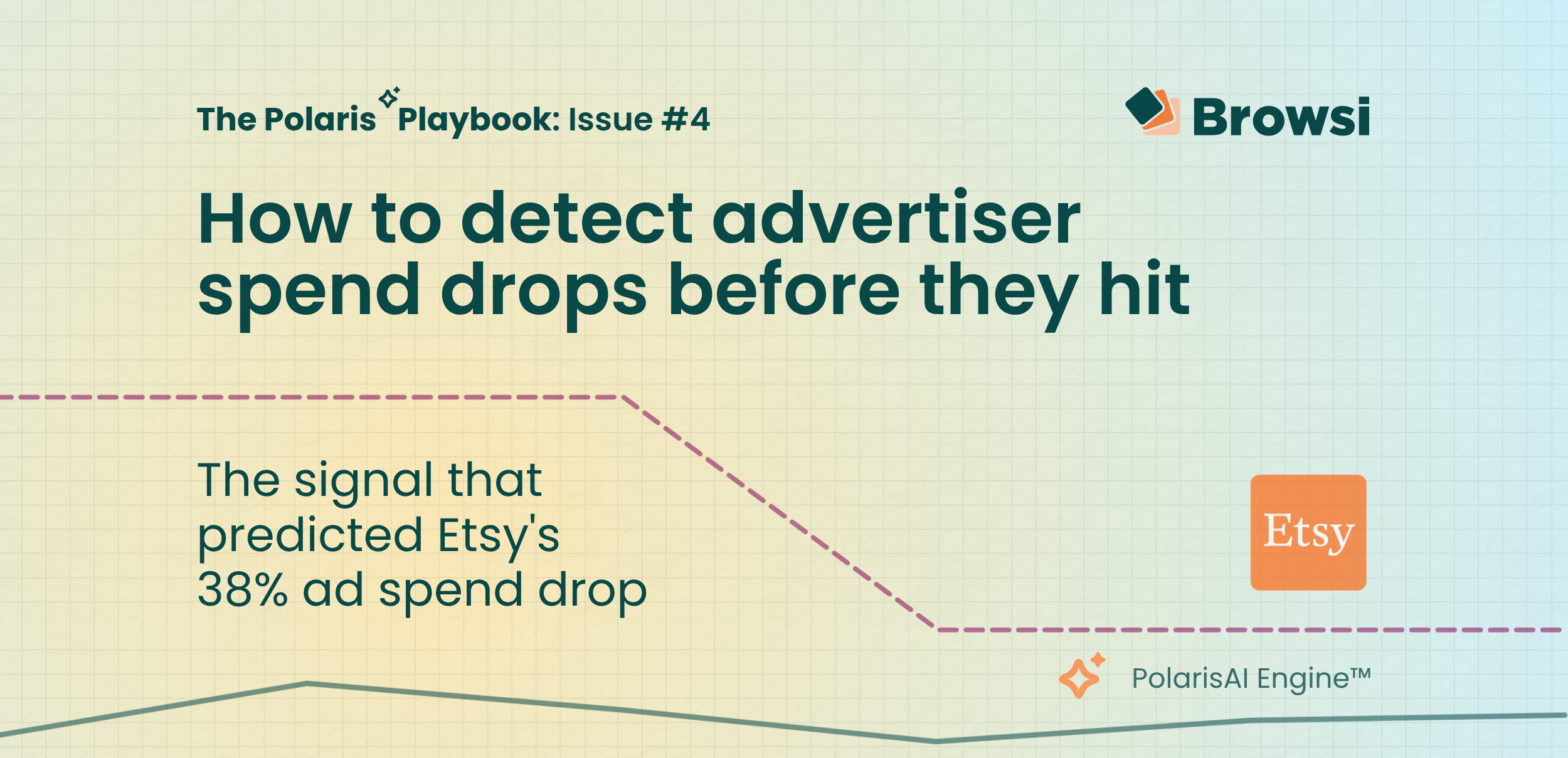
How to Detect Advertiser Spend Drops Before They Hit
Etsy's earnings confirmed what PolarisAI had already seen: a major pullback in marketing investment. By analyzing competitive signals before quarterly results were released, PolarisAI projected a 38% decline in spend while the market was still reacting to the underlying changes. The result highlights a growing reality for marketers: the most valuable competitive insights often emerge long before earnings calls explain them.
View Now