

The strategy behind the button: What millions of CTA impressions reveal about competitive strategy
By Asaf Shamly | July 6, 2026
One of the principles behind competitive intelligence is that strategy often hides in plain sight.
Marketing teams make thousands of small decisions every day, from budgets and audience targeting to creative messaging and CTA copy. Individually, those decisions don’t tell you much. Together, they reveal what the business is actually trying to accomplish.
This week, we’re looking at one of the simplest signals available: call-to-action buttons.
By analyzing millions of Meta ad impressions and their respective CTAs across Netflix, Prime Video & Amazon MGM Studios, HBO MAX TV, and Disney+ Hotstar, PolarisAI uncovers how a few words – Sign Up, Watch More, Learn More – can reveal whether a platform is prioritizing subscriber growth, viewer engagement, or something in between.
Each tells a story about where each platform thinks it is most vulnerable.
CTAs as strategic signals
Every call-to-action is designed to encourage a specific behavior.
A “Sign Up” CTA is about acquiring new subscribers. “Watch More” and “Learn More” encourage audiences to discover more content and continue engaging with the platform. Each reflects the action the advertiser wants its audience to take at a particular stage of the customer journey.
Individually, these are just creative decisions. But when you analyze CTA distribution across millions of impressions, they become strategic signals. They reveal which stage of the customer journey a platform is investing in most heavily.
For streaming platforms, that distinction is particularly meaningful. Unlike most advertisers, they have to solve two problems at once: attracting new subscribers while giving existing ones a reason to stay. CTA distribution offers a glimpse into which side of that equation a platform appears to be prioritizing.
Hunters vs. keepers
At first glance, every streaming platform seems to be doing the same thing. They’re all advertising on Meta, and they’re all promoting content. But once you group campaigns by CTA, the market splits into two very different strategies: the hunters and the keepers.

On one side are Disney+ and HBO Max.
Disney+ directs approximately 92% of its Meta impressions toward Sign Up CTAs, while HBO Max follows closely behind at 89%. For both platforms, Meta appears to be first and foremost an acquisition channel, with the overwhelming majority of impressions encouraging audiences to subscribe.
On the other side is Amazon Prime Video.
Approximately 87% of its impressions are built around engagement-focused CTAs, led by Watch More, while acquisition messaging accounts for only a small share of activity. One possible interpretation is that Prime Video is using Meta less to acquire new subscribers and more to encourage existing Prime members to spend more time watching content.
Then there’s Netflix.
Rather than leaning heavily toward acquisition or engagement, Netflix appears to be investing meaningfully in both. It’s the only platform that doesn’t fit neatly into either camp.
Instead of a single industry playbook, the streaming market reveals three distinct approaches: Disney+ and HBO Max are hunting for new subscribers, Amazon Prime Video is focused on keeping viewers engaged, and Netflix is trying to do both.
Netflix: The only platform playing both sides

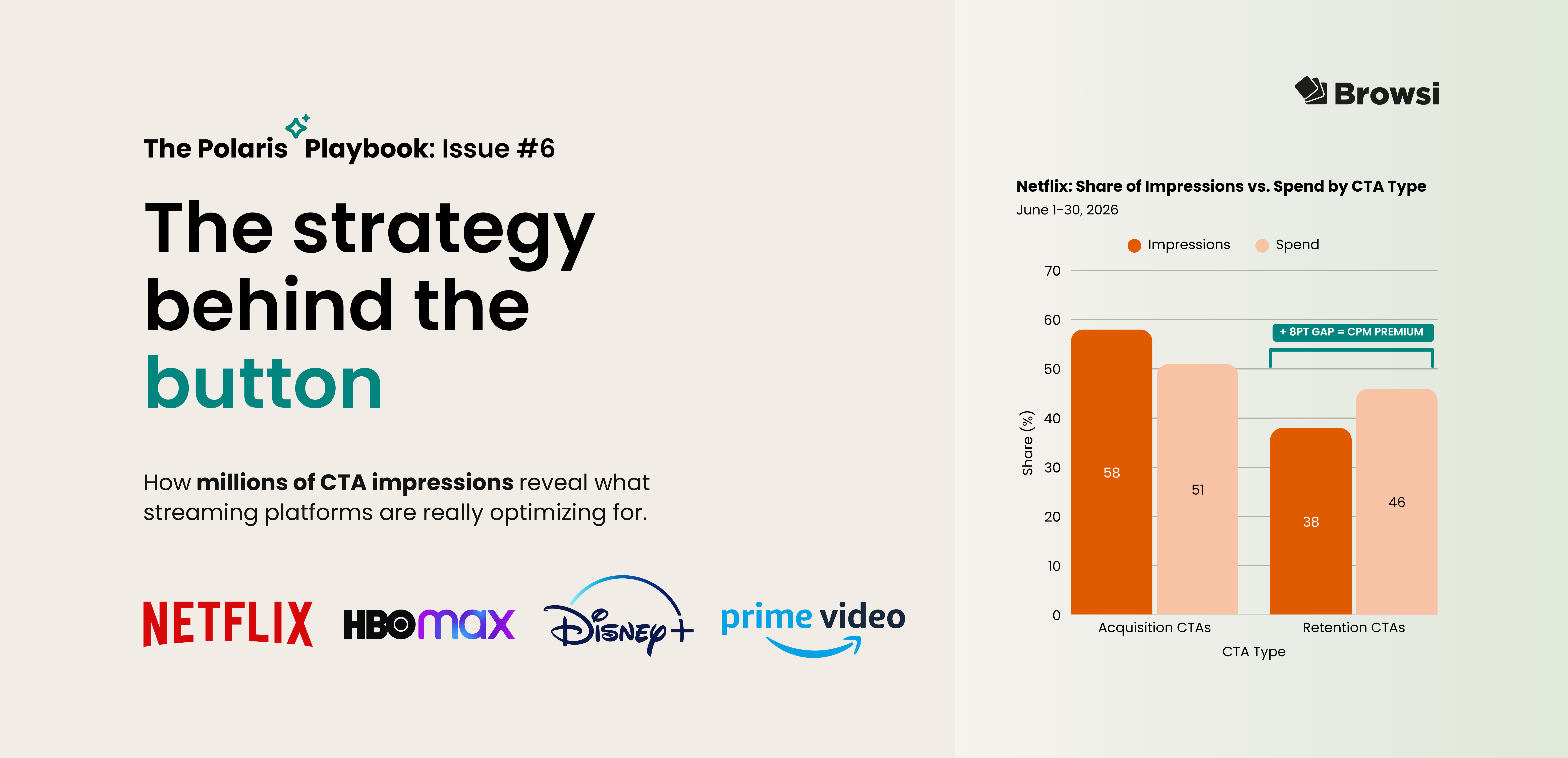
Netflix is the outlier. Over the last 30 days, 58% of its Meta impressions were acquisition-focused (“Sign Up”), while 38% encouraged audiences to “Watch More” or “Learn More”. Here’s the part that caught our attention.
While engagement-focused campaigns generated just 38% of impressions, they accounted for 46% of Netflix’s spend. That means Netflix is paying more to reach audiences through engagement campaigns than acquisition campaigns.
There are a few possible explanations. Engagement audiences may simply be more competitive to reach, or Netflix may be intentionally investing more heavily in keeping high-value viewers engaged.
While we can’t say which explanation is correct from CTA data alone, Netflix is allocating a disproportionately large share of its paid social investment to engagement campaigns.
That suggests engagement isn’t just a supporting objective. It’s valuable enough to command a larger share of spend than the impression volume alone would suggest.
Amazon Prime: Doubling down on engagement
If Prime Video was already leaning toward engagement over acquisition, the last seven days makes that strategy even more obvious.

Over the full month, acquisition-focused CTAs represented roughly 12% of Prime Video’s Meta impressions. During the final week, that falls to just 1.3%. That’s a meaningful shift rather than normal week-to-week variation.
Without campaign-level context, it’s impossible to know exactly why. It could reflect a scheduled content launch, a temporary budget reallocation, or another strategic decision.
What’s important is that the competitive landscape changed in real time. For one week, a platform serving hundreds of millions of Meta impressions substantially reduced acquisition-focused messaging, creating a temporary opening competitors could potentially exploit.
And the creative mix reinforces that pattern.

Prime’s highest reaching creatives during the period are all “Watch More” dynamic video ads, including promotions for its summer content slate and the series Off Campus. Notably, none of the platform’s highest-performing creatives use a “Sign Up” CTA.
That doesn’t necessarily mean Prime Video has abandoned subscriber acquisition on Meta. But it does suggest that, during this period, its paid social activity was overwhelmingly focused on encouraging audiences to watch specific content rather than subscribe.
Taken together, the CTA distribution, creative messaging, and creative formats all point in the same direction. Prime Video appears to be using Meta primarily as a content engagement channel, with subscriber acquisition playing a much smaller role than it does for its major streaming competitors.
HBO Max: Moving in the opposite direction

HBO Max sits at the opposite end of the spectrum from Prime Video.
Approximately 89% of its Meta impressions carry “Sign Up” CTAs, making it one of the most acquisition-focused advertisers in the category.
The trend becomes even more clear when you compare the last 7 days with the full 30-day period. During the final week alone, HBO Max generated approximately 8.8 million “Sign Up” impressions, compared with 23.5 million across the entire month, suggesting acquisition activity accelerated toward the end of the period.
Its acquisition campaigns also account for a larger share of spend than impressions, indicating HBO Max is willing to pay a premium to reach audiences it believes are more likely to convert.
Creative Analysis

All of HBO Max’s highest-reaching creatives promote the Disney+, Hulu, and HBO Max bundle for $19.99 per month. None of them lead with a flagship series, a blockbuster release, or exclusive content.
Perhaps HBO Max doesn’t believe it can win the acquisition argument on content alone. Instead, its strongest acquisition message appears to be value: three streaming services for one monthly price. The CTA says “Sign Up.” The creative says “Look how much you get for $19.99.”
Whether that’s a response to competitive pressure, a deliberate positioning strategy, or simply the focus of this campaign window is impossible to know from advertising data alone. But it does suggest that, during this period, HBO Max consistently positioned the bundle—not individual content, as its primary reason to subscribe.
Individually, each of these signals tells only part of the story. Together, they paint a remarkably consistent picture: HBO Max is using Meta primarily as an acquisition channel, while Prime Video is using it primarily as a content engagement channel.
Disney+: Acquisition at any cost

Disney+ directs approximately 92% of its Meta impressions toward “Sign Up” CTAs. Engagement-focused messaging accounts for less than 1% of its social presence. That makes Disney+ the most acquisition-focused advertiser in the category.
Unlike Netflix, which divides its investment between acquisition and engagement, or Prime Video, which leans heavily into content activation, Disney+ has assigned Meta a very specific role: bringing new subscribers into the ecosystem. The interesting question isn’t whether Disney+ is trying to grow. It’s why Meta is being used almost exclusively for acquisition. Nearly every impression is asking audiences to do the same thing: Sign up.
In competitive intelligence, what’s often most revealing isn’t just what a brand chooses to do. It’s what it chooses not to do.
So… Is Disney+ heavy acquisition strategy channel specific?
While Meta is almost entirely focused on conversion, Disney+’s open web activity is built for scale.
Over the last 30 days, the platform delivered nearly 13.8 billion impressions across the open web, roughly 29 times its Meta impression volume. Click-through rate sits at approximately 0.13%, with 48.5% viewability, a combination that’s far more consistent with broad awareness and content discovery than direct-response advertising.
Unlike Meta, the open web doesn’t provide explicit CTA labels but the behavioral signals tell their own story: enormous reach, relatively low CTR, and moderate viewability point to a channel designed to keep Disney+ visible rather than immediately convert subscribers. Viewed together, the two channels appear deliberately complementary.
The open web builds awareness at scale. Meta captures demand.
The takeaway
Every ad decision (which CTA to use, how much to spend on it, which creative to pair it with) looks tactical in isolation. But when you aggregate millions of impressions, those individual choices start to reveal something much bigger. Each platform appears to be using paid social to solve a different business problem.
Amazon Prime Video is overwhelmingly using Meta as a content engagement channel. Acquisition messaging is almost absent, while its highest-reaching creatives encourage audiences to watch more rather than subscribe. Combined with the broader Prime ecosystem, one possible interpretation is that Meta plays a much larger role in engagement than subscriber acquisition.
HBO Max has taken the opposite approach. Nearly every impression is acquisition-focused, yet its highest-performing creatives don’t lead with flagship content — they lead with the value of the Disney+, Hulu, and HBO Max bundle. The CTA says “Sign Up.” The creative says “Look how much you get.” Whether intentional or campaign-specific, value appears to be its primary acquisition message during this period.
Disney+ has created a clear division of labor across channels. The open web delivers enormous reach and broad awareness, while Meta is almost entirely dedicated to conversion. Rather than asking existing viewers to engage, nearly every social impression asks one thing: Sign Up.
Netflix is the only platform meaningfully investing in both acquisition and engagement. More interestingly, engagement campaigns account for a disproportionately large share of spend, suggesting Netflix places greater value on those audiences than impression volume alone would imply.
None of these PolarisAI observations proves strategy on its own. But when CTA distribution aligns with spend, creative messaging, formats, and cross-channel behavior, a much clearer picture begins to emerge. That’s what makes competitive intelligence so powerful.
Most marketers look at an ad and ask, “What is my competitor saying?” The better question is: “Why are they asking people to do that?”
Sometimes, the answer is hiding in a single button.
Latest Articles
-
The 6-step framework for turning signals into strategy
Competitive intelligence only matters if it leads to action. In this edition of The Polaris Playbook, we use Honda and five competitors to demonstrate a practical six-step framework for turning competitive signals into strategic recommendations marketers can actually use.
View Now -
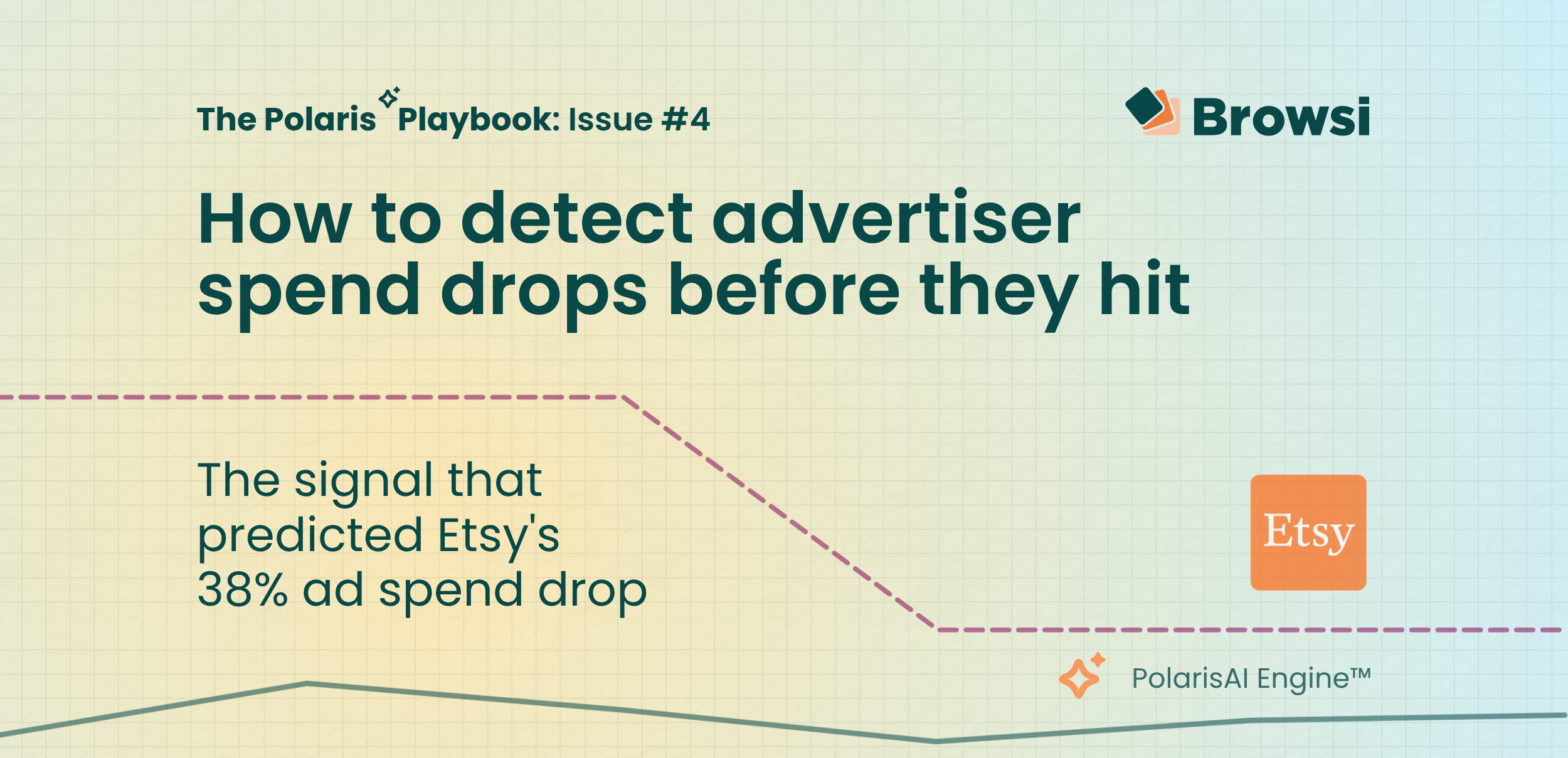
How to Detect Advertiser Spend Drops Before They Hit
Etsy's earnings confirmed what PolarisAI had already seen: a major pullback in marketing investment. By analyzing competitive signals before quarterly results were released, PolarisAI projected a 38% decline in spend while the market was still reacting to the underlying changes. The result highlights a growing reality for marketers: the most valuable competitive insights often emerge long before earnings calls explain them.
View Now -

How Accurate is Browsi’s Data? Tried and Tested.
Most marketers trust competitive spend data without questioning where the numbers come from. We tested PolarisAI Engine™ against the only benchmark that matters: what advertisers actually reported in their earnings calls. The result was an 87% correlation across five major brands, revealing the difference between data that looks confident and data grounded in reality.
View Now