

When AI Becomes the Storefront, Advertisers Need to See Beyond the Chat Window
By Asaf Shamly | November 13, 2025

September’s rollout of ChatGPT Shopping was barely noticed outside tech circles, but it might end up being one of the biggest digital media changes since the search bar.
For the first time, OpenAI turned ChatGPT into a fully functional shopping interface, where users can search, compare, and buy (!!) products without visiting any form of a retailer’s website.
Ask for “a waterproof jacket under $150,” and the chat not only recommends options, it actually handles checkout through the new Agentic Commerce Protocol. The user never leaves the conversation.
That’s a new default interface for decision-making.
From search engines to sentence engines
For two decades, brand discovery happened in search boxes and social feeds. Every click led somewhere measurable. Every impression could be tracked, attributed, and optimized.
Now, AI assistants collapse that process. The “path to purchase” becomes a single exchange – summarized, ranked, and filtered by a system that doesn’t need to show its work.
This is what makes conversational commerce such a game-changer: it rewrites where and how attention forms.
For advertisers, that should sound familiar (and troubling).
We’ve spent years optimizing campaigns around platforms whose logic we could roughly figure out: keywords, auctions, audience segments, formats. But AI-driven interfaces introduce a new layer of mystery.
What defines visibility when the conversation itself becomes the medium? (Marshall McLuhan would have something to say about that).
What GEO teaches us about attention
Optimizing product data so AI systems can understand and recommend it – in other words, the rise of Generative Engine Optimization (GEO) in retail – should feel like déjà vu to anyone in media. The challenge advertisers face now is similar: how to make sure their message is interpretable to algorithms that decide what users see.
GEO is forcing e-commerce brands to rethink product feeds, descriptions, and metadata so they “speak AI.”
Advertisers must do the same for creative and context-understanding – taking control of how their ads are processed, ranked, and surfaced across the open web.
The real competition is for comprehension
In AI-mediated environments, attention behaves like currency – limited, dynamic, and exchangeable in real time.
Two brands may buy into the same audience, geography, or topic, and still see wildly different results depending on how their creatives perform in context.
Understanding that delta – what competitors are showing, how they’re performing, and where share of voice is shifting – is becoming the cost of entry.
Seeing what the interface hides
ChatGPT Shopping represents the future of AI-mediated commerce, but it also shows a deeper truth about digital advertising: the smoother the interface, the less transparent it is for brands.
Visibility is spreading across devices, agents, and environments we don’t fully control.
Instead of chasing every new interface, brands need a wider lens – one that sees beyond their own campaigns and takes in the full environment their messages live in.
Benchmark performance against competitors.
Identify where attention leaks.
Understand the environmental signals that determine whether your ads are actually being seen..or simply technically delivered.
AI mediates everything in this new world, from what we read to what we buy, and perception? It’s what makes all the difference.
Latest Articles
-
The World Cup’s best advertising window isn’t the final.
Conventional wisdom says the knockout rounds are the best time to advertise during the FIFA World Cup. PolarisAI's analysis of Meta campaigns across major beverage brands tells a different story. By comparing Coca-Cola's official World Cup creative with Pepsi's tournament-adjacent strategy, we found that advertising efficiency peaked earlier in the tournament, even as audiences continued to grow.
View Now -
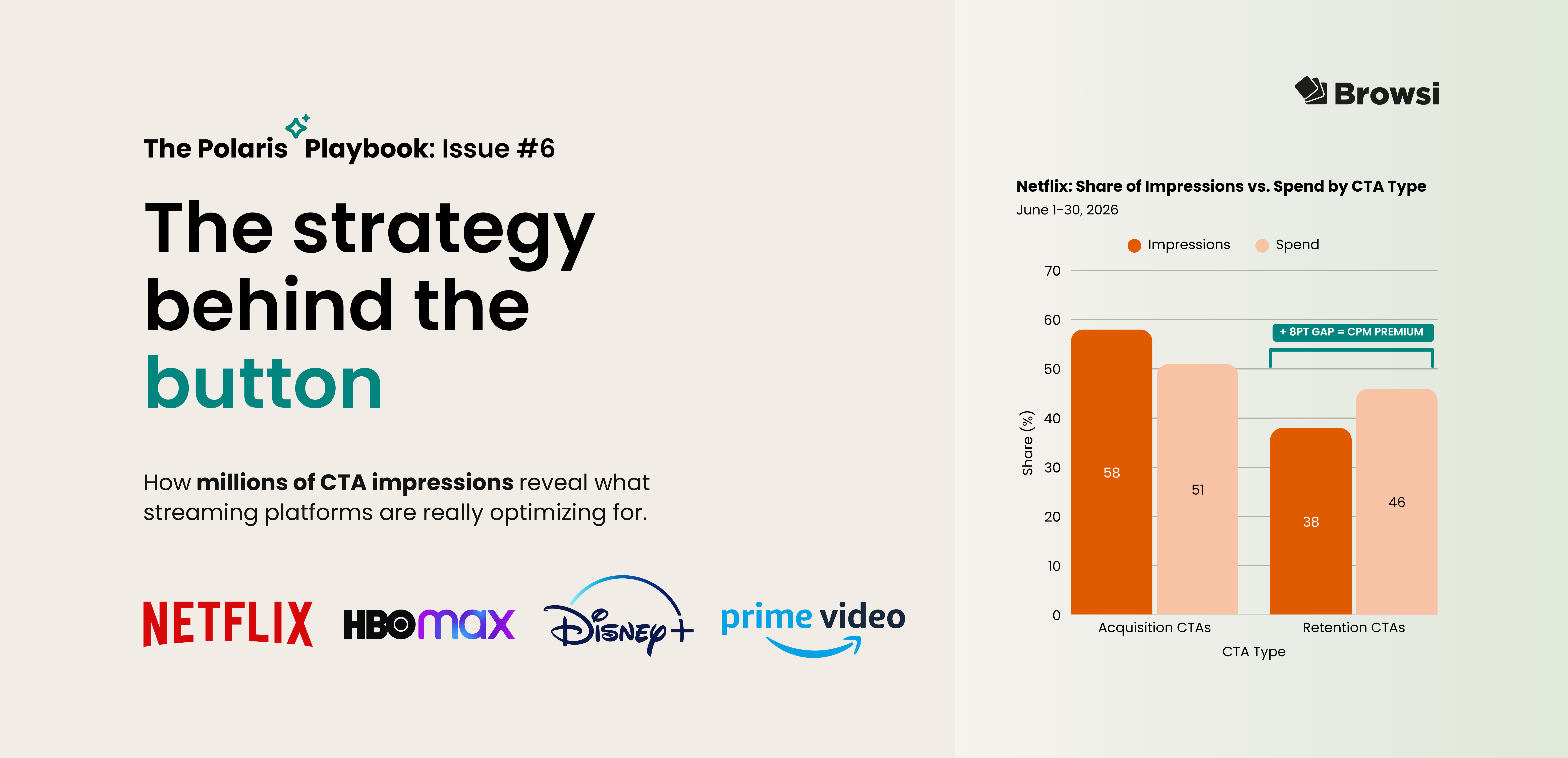
The strategy behind the button: What millions of CTA impressions reveal about competitive strategy
What can a single CTA button reveal about a company's marketing strategy? By analyzing millions of Meta ad impressions, PolarisAI uncovers how Netflix, Prime Video, HBO Max, and Disney+ use "Sign Up," "Watch More," and other CTAs to prioritize subscriber acquisition, viewer engagement, and broader competitive strategy.
View Now -
The 6-step framework for turning signals into strategy
Competitive intelligence only matters if it leads to action. In this edition of The Polaris Playbook, we use Honda and five competitors to demonstrate a practical six-step framework for turning competitive signals into strategic recommendations marketers can actually use.
View Now