

Your Media Plan is Still Yours – Until it Isn’t
By Lior Fisher | August 28, 2025
Earlier this month, Elon Musk introduced Grok as the engine behind X’s future in advertising. An autonomous system, powered by a proprietary AI, designed to handle targeting, creative optimization, brand safety, and delivery – all with minimal human input.
The pitch is clarity and control at scale..the reality, for many brands, has been closer to guesswork in a closed box.
Advertisers who’ve tested the system describe a lack of transparency. Performance didn’t justify the promise. And when questions were raised, few answers followed.
This wasn’t the failure of a product launch.
It was a glimpse into a larger shift happening across the industry.
Platforms aren’t offering AI support. They’re building AI control.
More and more, platforms are presenting AI not as an assistant to media strategy, but as its replacement. They’re training systems to manage spend, determine placement, and shape messaging – and then asking brands to step back.
It’s framed as efficiency.
But what it really does is consolidate decision-making where visibility is thinnest.
These systems rarely provide context. They don’t expose what data was used to guide their choices. They’re trained on internal feedback loops and operate within platform-specific logic. They optimize for what’s measurable inside their ecosystem – not what aligns with the brand’s broader strategy.
That creates a subtle, but critical, shift. Advertisers aren’t simply delegating tasks..they’re handing over understanding.
Fluency isn’t the same as strategy
Tools like Grok are designed to act quickly. They move spend, rewrite copy, and generate results dashboards in real time. But their speed masks a gap in perception.
They don’t evaluate sentiment drift across content.
They can’t track user attention through friction-heavy layouts.
They don’t compare performance across environments.
And they aren’t built to show you where your competitors are – or how you stack up.
What they offer is automation.
What they lack? perspective.
Alignment requires more than outputs
The more control platforms assume, the less visibility brands retain.
When you rely on a system you can’t interrogate, you lose the ability to adapt. You lose the nuance behind the numbers. And you risk building campaigns that succeed in metrics – while missing in market.
Autonomy without insight = dependency.
The media landscape is changing so fast, and that kind of dependability comes at a price.
Smarter AI begins with shared ground
If AI is going to act on behalf of advertisers, the foundation matters.
Systems that are trained on isolated platform data, fed through internal taxonomies, and tuned to optimize within a self-contained loop will always reach limits.
The systems that drive real value are the ones that see clearly – across formats, across signals, across competition.
And the brands that stay ahead won’t be the ones who automate first.
They’ll be the ones who understand what the systems they’re using understand..and what they don’t.
Latest Articles
-
The World Cup’s best advertising window isn’t the final.
Conventional wisdom says the knockout rounds are the best time to advertise during the FIFA World Cup. PolarisAI's analysis of Meta campaigns across major beverage brands tells a different story. By comparing Coca-Cola's official World Cup creative with Pepsi's tournament-adjacent strategy, we found that advertising efficiency peaked earlier in the tournament, even as audiences continued to grow.
View Now -
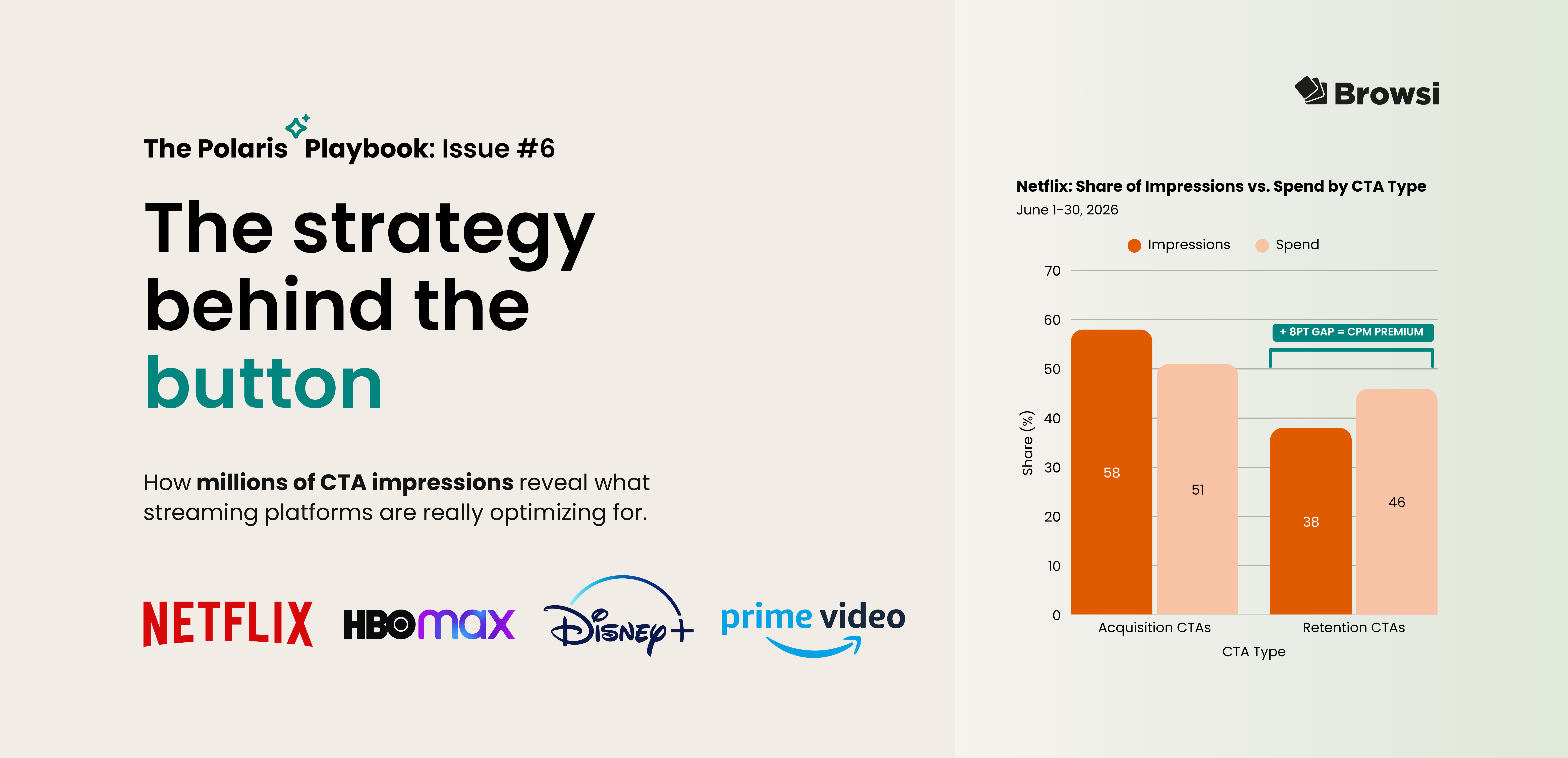
The strategy behind the button: What millions of CTA impressions reveal about competitive strategy
What can a single CTA button reveal about a company's marketing strategy? By analyzing millions of Meta ad impressions, PolarisAI uncovers how Netflix, Prime Video, HBO Max, and Disney+ use "Sign Up," "Watch More," and other CTAs to prioritize subscriber acquisition, viewer engagement, and broader competitive strategy.
View Now -
The 6-step framework for turning signals into strategy
Competitive intelligence only matters if it leads to action. In this edition of The Polaris Playbook, we use Honda and five competitors to demonstrate a practical six-step framework for turning competitive signals into strategic recommendations marketers can actually use.
View Now