

Most brands think they are data driven. They’re not.
By Asaf Shamly | April 27, 2026
I have to be honest about something.
Most marketers aren’t optimizing for performance. They’re optimizing for what’s easy to measure.
And more specifically, they’re optimizing based on their own numbers, not their competition’s.
Impressions; reach; clean, reportable metrics that are easy to justify.
But those numbers don’t tell you anything about impact.
The edge isn’t more (of your own) data
I’ve seen teams with more dashboards, more reports, and more numbers, yet still missing the bigger picture.
Why? Because they’re only looking at themselves.
That’s exactly why we built PolarisAI. It doesn’t just show you your data. It shows you your market.
In this newsletter, I break down what happens when you start with real-time, competitive intelligence instead of your own internal metrics.
So let’s put that to the test: American Express vs. PayPal.
When more spend just means you’re more expensive
Here’s a simple view from my PolarisAI dashboard: CPM vs CTR.
Sounds obvious. But it’s not something you actually see anywhere else.
If you only look at spend – like most competitive intelligence tools do – you’d assume American Express is winning. Higher investment = higher performance, right?
Well, that depends on the question you ask.
If the question is: “Who’s spending more?” You already have your answer. A better question: Who’s actually getting more out of what they spend?

Here’s what the Two-Factor Analysis actually revealed:
American Express’s CPM is ~2x higher than PayPal’s, but PayPal is matching them where it matters:
– CTR: 0.19% vs 0.18%
– CPM: $0.71 vs $1.53
When comparing estimated spend against CTR, POLARIS.AI™ revealed the same story, except now the gap is even starker.
Amex is spending ~6x more than PayPal for virtually the same result.
Same market. Same competition. Completely different efficiency.

Now, this isn’t to say CTR is the ultimate measure of success.
But what it does show is this: PayPal is doing something American Express isn’t and getting comparable results for significantly less.
So… I dug deeper
The data is live, so I went straight to strategy. I asked POLARIS AI™: “What are they actually doing differently?”


What I got was actual data-driven marketing:
– PayPal spend less and win more → $0.33 per click vs. Amex’s significantly higher cost. Same auction. Completely different outcome.
– Their targeting is surgical, not scattered → 2,734 sites vs. Amex’s 3,685. Less spread, more signal.
– They keep it simple → “Scan. Pay. Go.” → clear, action-driven, effective
– They don’t just place ads. They place them well. Premium positions with 18.49 seconds average dwell time. Users don’t just see the ad. They stay.
Same ideas, better execution.
The takeaway
If you look at impressions, you’d think American Express is winning. If you look at outcomes, you see PayPal is more efficient. If you look at why, you get a strategy.
That’s the part that makes “marketers”, marketers.
And it’s the part that gets ignored.
And this took me 15 minutes (10, if I skipped the coffee).
Maybe the issue isn’t that marketers don’t want better answers. Maybe they don’t have the right tools.
But this is the real point:
When you move beyond surface metrics, you stop making educated guesses and start making informed decisions.
If you’re curious what this looks like in your space, you can try PolarisAI for free.
Latest Articles
-
The World Cup’s best advertising window isn’t the final.
Conventional wisdom says the knockout rounds are the best time to advertise during the FIFA World Cup. PolarisAI's analysis of Meta campaigns across major beverage brands tells a different story. By comparing Coca-Cola's official World Cup creative with Pepsi's tournament-adjacent strategy, we found that advertising efficiency peaked earlier in the tournament, even as audiences continued to grow.
View Now -
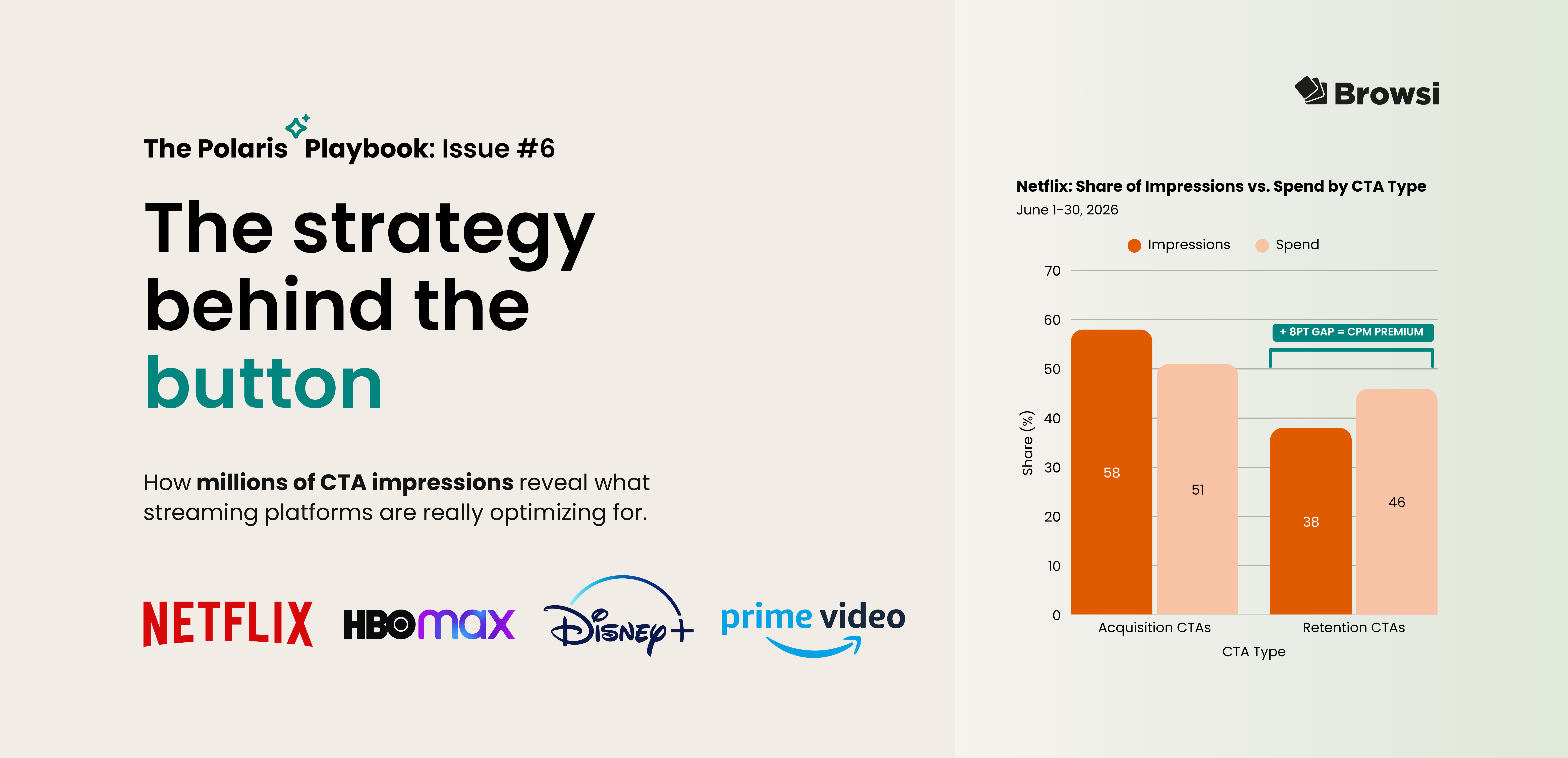
The strategy behind the button: What millions of CTA impressions reveal about competitive strategy
What can a single CTA button reveal about a company's marketing strategy? By analyzing millions of Meta ad impressions, PolarisAI uncovers how Netflix, Prime Video, HBO Max, and Disney+ use "Sign Up," "Watch More," and other CTAs to prioritize subscriber acquisition, viewer engagement, and broader competitive strategy.
View Now -
The 6-step framework for turning signals into strategy
Competitive intelligence only matters if it leads to action. In this edition of The Polaris Playbook, we use Honda and five competitors to demonstrate a practical six-step framework for turning competitive signals into strategic recommendations marketers can actually use.
View Now